
23 Feb What Is the Creator Economy? Market Size, Trends, and Statistics in 2026
Summary
The 2026 Creator Economy Report: 30+ Essential Statistics & Trends for Influencer Marketing
Influencer marketing has become one of the most effective ways for brands to reach, engage, and convert consumers. In 2026, creators are no longer treated as experimental partners – they are now essential and integral to how companies build awareness, trust, and long-term loyalty.
The 2026 Creator Economy Report combines large-scale third-party platform data contributed by HypeAuditor with original survey research to provide a clear, practical view of today’s influencer landscape. Drawing insights from more than five million creator accounts and 1,000 U.S.-based creators, this report helps marketers understand where audiences are spending time, how creators are earning, and which strategies are delivering real business results.
Whether you are planning your next campaign, evaluating creator partnerships, or refining your digital strategy, this report offers reliable benchmarks and actionable guidance for navigating influencer marketing in 2026.
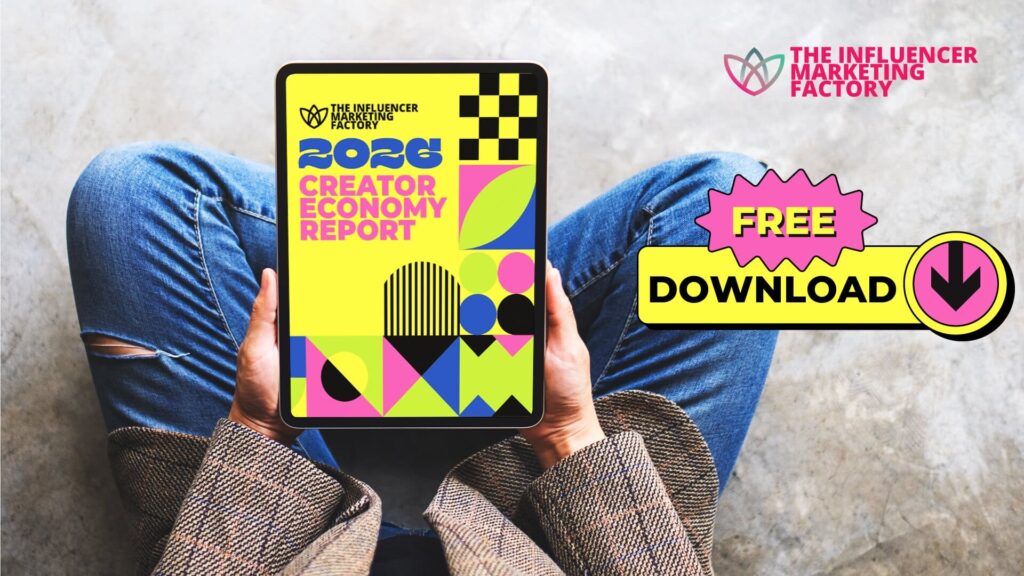
Download the creator economy 2026 report for Free
Executive Summary: The State of Influencer Marketing in 2026
Influencer marketing in 2026 reflects a more mature, performance-driven industry. Creators are increasingly operating as professional media businesses, focused on consistency, quality, and long-term growth rather than short-term visibility.
Audience behavior continues to shift toward social-first discovery. The 25-34 age group is now the largest audience segment across major platforms, while younger users rely on creator content for search, recommendations, and purchasing decisions. Short-form video remains the primary engagement driver, with TikTok and YouTube Shorts leading in reach and discoverability.
Monetization is also evolving. Creators are building diversified income models that combine brand partnerships with affiliate marketing, product sales, digital downloads, and subscriptions. These blended revenue streams reduce financial volatility and support sustainable growth.
For brands, accountability is now a priority. Marketers are placing greater emphasis on ROI, audience quality, and long-term partnerships. Campaigns built around trust, relevance, and consistent collaboration are outperforming one-off activations, reinforcing the importance of strategic creator relationships.
Key Influencer Marketing Statistics Marketers Need to Know in 2026
As influencer marketing budgets grow, data-driven decision-making has become essential. Marketers need reliable insights into platform performance, creator behavior, and audience engagement to stay competitive.
This section highlights the most important influencer marketing statistics for 2026, offering practical context for campaign planning, creator selection, and performance optimization.
Platform Growth & User Engagement Trends
Short-form video continues to dominate user engagement across social platforms. TikTok maintains the most consistent median engagement rates across audience sizes, making it one of the most accessible platforms for creators at every stage.
YouTube Shorts is gaining momentum, particularly among mid-sized and growing creators, while Instagram Reels remains a major distribution channel despite declining engagement at higher follower levels. This trend reflects increasing competition and rising content volume on Instagram.
Platforms that prioritize algorithm-driven discovery and video-first formats continue to deliver the strongest organic reach. For brands, this reinforces the importance of investing in creative, platform-native video content.
Creator Earnings & Monetization Trends
Creator income in 2026 is more diversified than ever before. While brand partnerships remain a core revenue source, creators are increasingly focused on building scalable, long-term income streams.
Affiliate marketing, product and merchandise sales, digital products, and subscription-based content now represent a meaningful share of total earnings. Passive revenue streams account for more than 20% of creator income, signaling a shift toward sustainable business models.
Our survey data also highlights the emergence of a creator “middle class.” Nearly half of creators earn between $10,000 and $100,000 annually, demonstrating that consistent, professional content creation can support stable livelihoods.
Brand Partnership ROI & Performance Metrics
In 2026, brands are evaluating influencer partnerships with greater precision. Engagement rate, audience authenticity, conversion tracking, and attribution modeling are now standard performance indicators.
Long-term collaborations continue to deliver stronger results than short-term campaigns. Nearly half of creators prefer ongoing partnerships that allow for deeper storytelling and brand alignment. These relationships tend to generate higher trust, improved recall, and stronger customer lifetime value.
Advanced analytics platforms and third-party measurement tools are helping marketers connect creator activity directly to revenue and acquisition outcomes, strengthening confidence in influencer investments.
Audience Trust & Authenticity Data
Trust remains the foundation of successful influencer marketing. Audiences are more selective than ever, gravitating toward creators who demonstrate transparency, consistency, and genuine brand alignment.
Overly promotional content without clear value continues to see declining engagement. In contrast, creators who balance sponsored and organic content maintain stronger credibility and long-term community loyalty.
Most creators report feeling fairly valued by brand partners, reinforcing the importance of respectful, transparent collaboration. Authentic storytelling, relevance, and audience-first content consistently outperform high-volume promotional approaches.
Deep Dive: Our Analysis of 5M+ Creator Accounts
To deliver an accurate and comprehensive view of the creator economy, this report analyzes more than five million creator accounts across Instagram, TikTok, and YouTube.
All accounts included in the study met minimum activity thresholds and maintained a significant U.S.-based audience presence. This ensures that the data reflects real, active creators operating in today’s market.
The analysis examines engagement rates, audience demographics, content formats, growth patterns, and visibility barriers across follower tiers. By identifying how creators build reach and sustain momentum, this section provides a practical foundation for evidence-based influencer marketing strategies in 2026.
HypeAuditor Research Methodology
The Influencer Marketing Factory partnered with HypeAuditor to analyze creator performance, audience demographics, and content trends across Instagram, TikTok, and YouTube. This research examines engagement levels, active creator counts, popular content categories, and content performance among creators with predominantly U.S. audiences who published content in 2025 and have at least 10 total media posts on their respective platforms. All analyzed accounts were filtered to ensure a majority U.S.-based audience, defined as 40% or more followers from the United States. The dataset includes 5,192,108 Instagram creator accounts (personal/non-brand only), 2,986,001 TikTok creator accounts, and 1,098,662 YouTube creator accounts (both personal and brand accounts for TikTok and YouTube). Additional methodology details are provided throughout the report where applicable.
Finding #1: The 25-34 Age Group Now Dominates the Creator Economy
While TikTok still attracts younger users (40.6% under 25), the largest audience segment across all platforms is now 25-34. This signals a maturing creator economy and makes this age group the primary target for cross-platform brand campaigns.
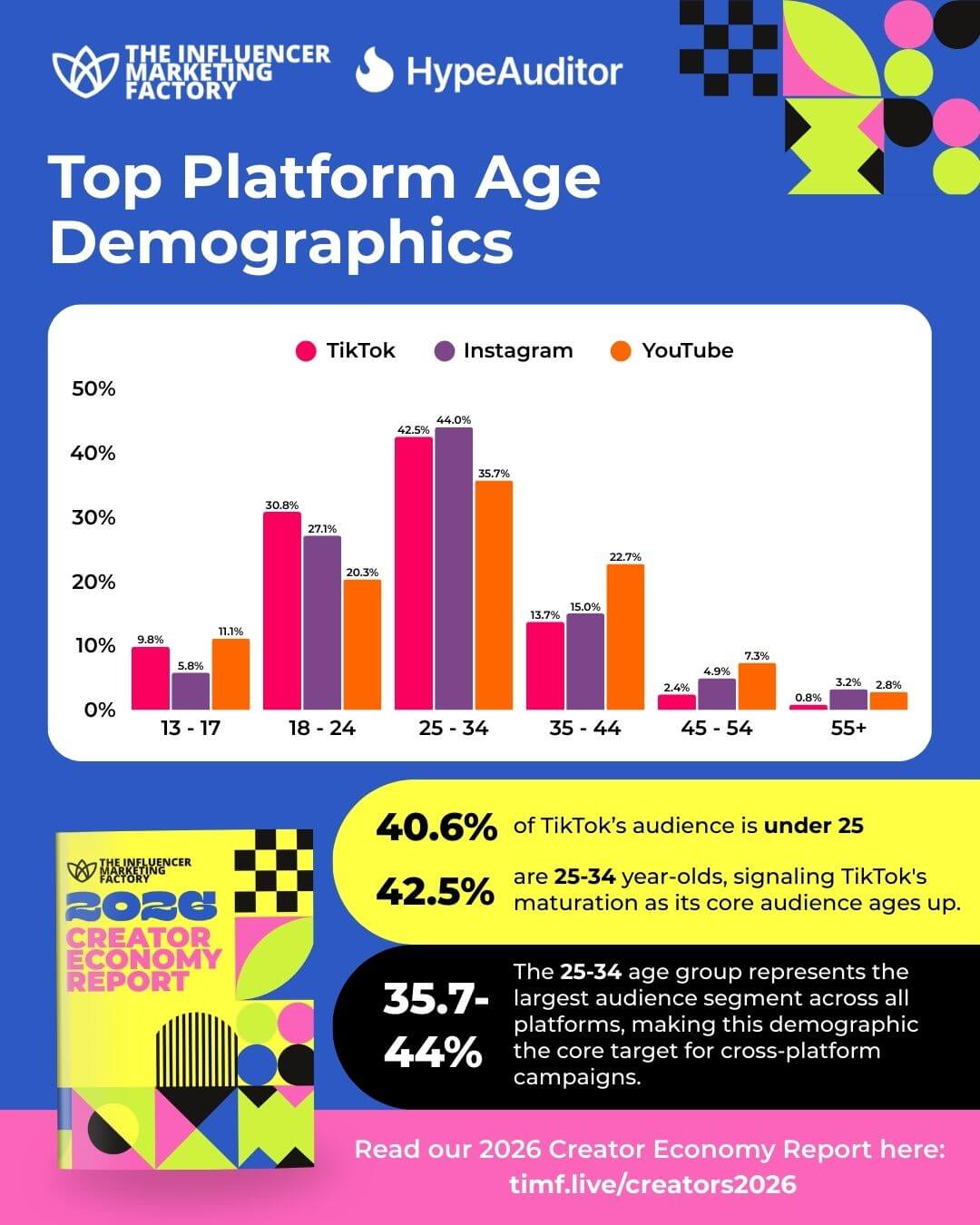
Top Platform Age Demographics breakdown
Finding #2: TikTok’s Algorithm Is the Most Creator-Friendly for Growth
TikTok is the most democratized short-form video platform among competitors. TikTok manages to have a steady median engagement rate across audience sizes, and Instagram Reels’ median engagement rates steadily drop as audiences increase.
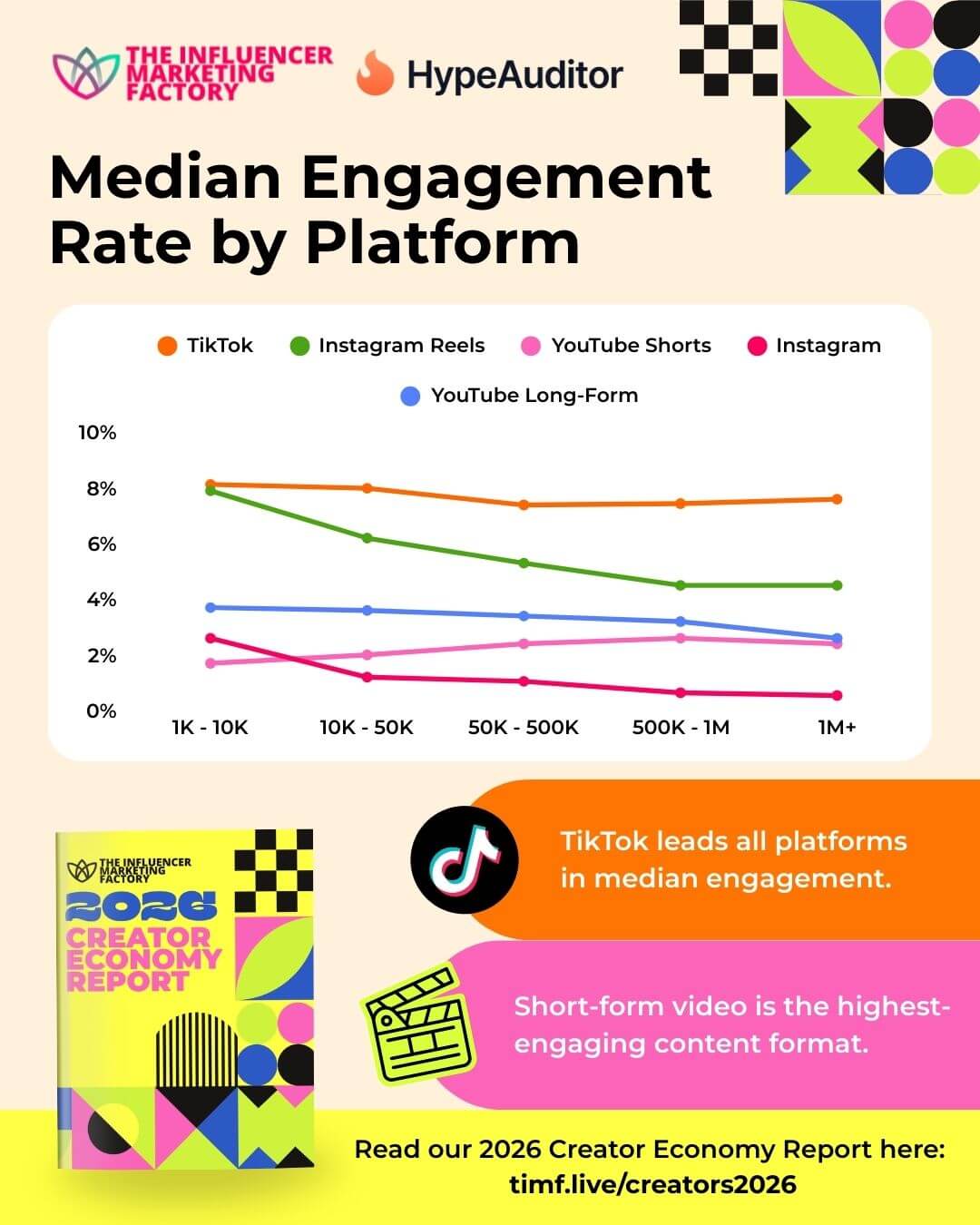
Median Engagement Rate by Platform in 2026
Finding #3: Short-Form Video Dominates Engagement Across Platforms
Short-form video delivers the strongest engagement across platforms. TikTok maintains the most consistent and highest median engagement, while YouTube Shorts shows improving engagement as creators grow. In contrast, Instagram Reels engagement declines as follower counts increase.
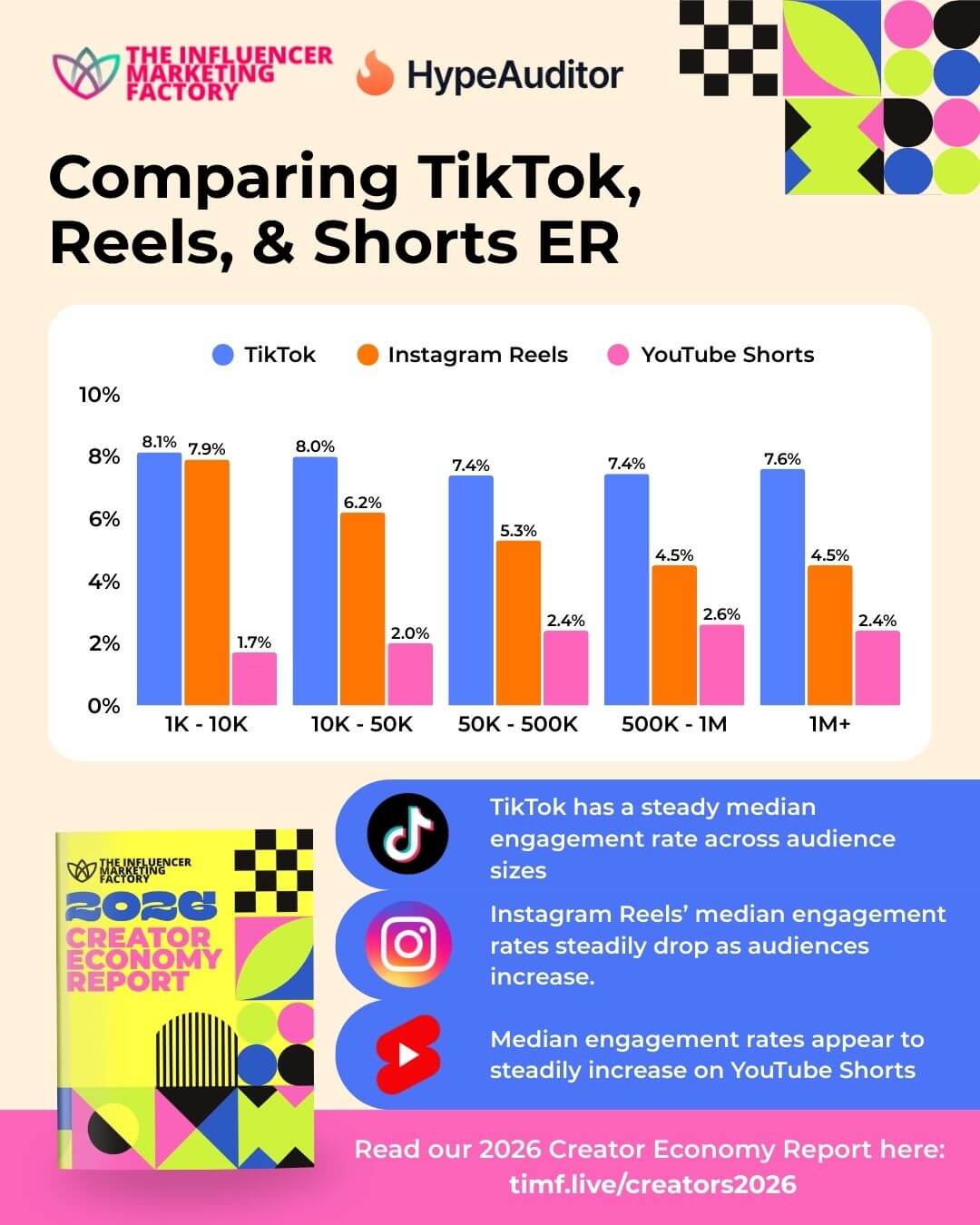
Comparing TikTok, Instagram Reels and YouTube Shorts Engagement Rate
Finding #4: Creators Struggle With the Visibility Barrier
The vast majority of U.S.-based creators struggle for visibility across all platforms. 46.2% of Instagram creators, 76% of TikTok creators, 59.1% of long-form YouTube creators, and 39.94% of YouTube Shorts creators receive fewer than 1K views per post, underscoring that building meaningful reach remains the primary challenge for most content creators.
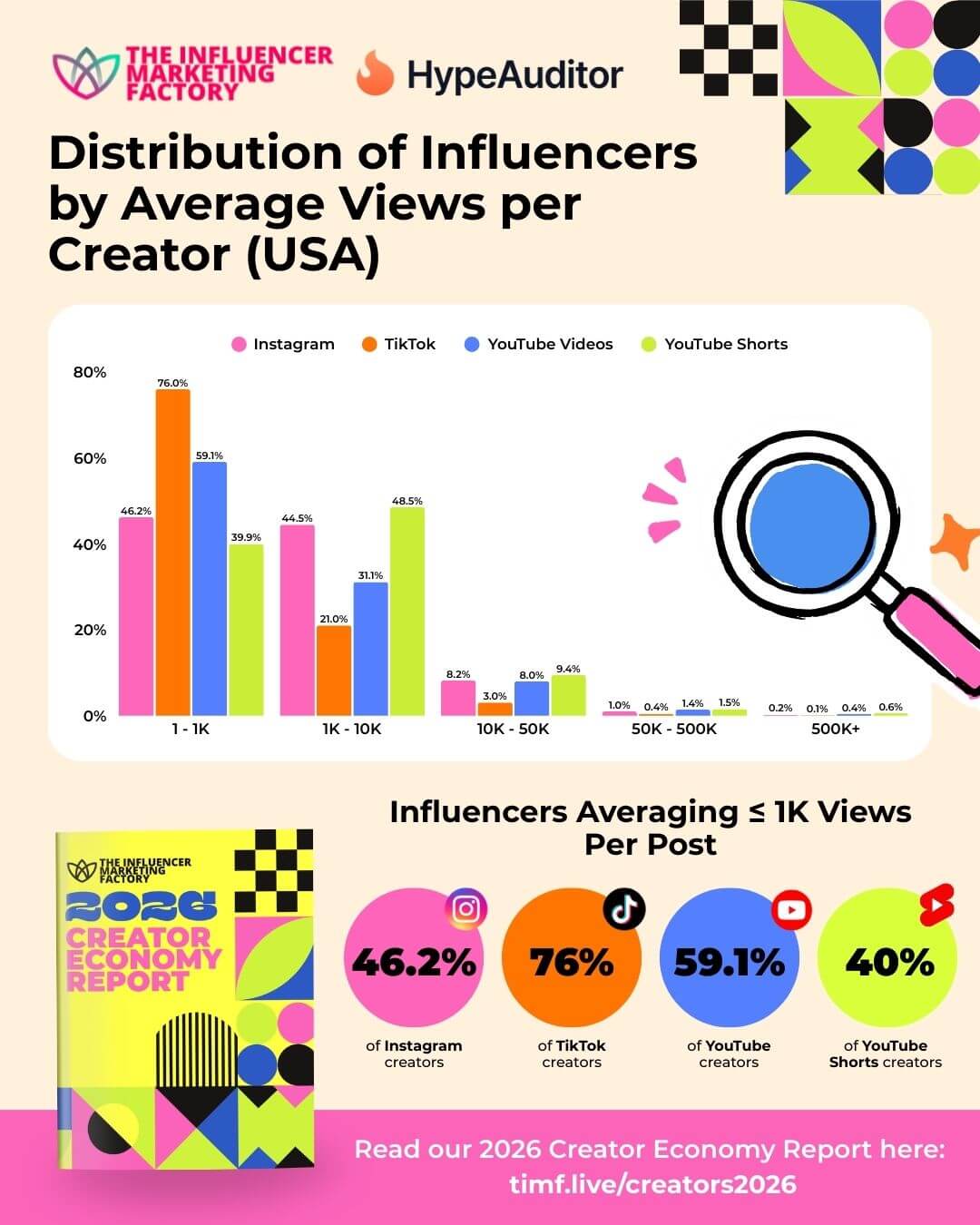
Distribution of Influencers by Average Views per Creator (USA)
Finding #5: Instagram’s Video-First Shift Is Overpowering Static Content
Instagram continues shifting toward video-first content. Reels grew by 3.8% from 2024 to 2025, while image posts declined by -6.41%, confirming that creators who rely on static content are losing visibility.
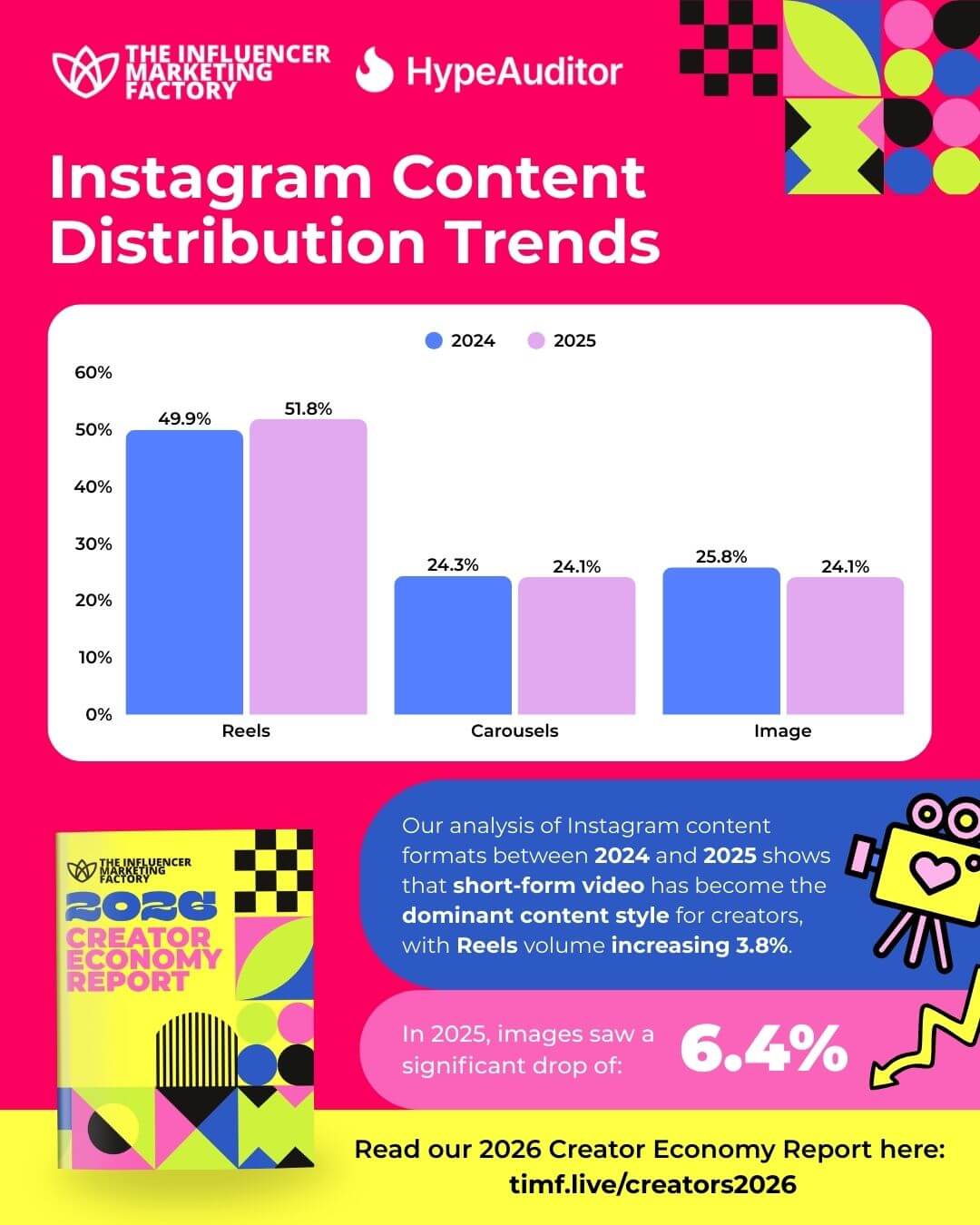
Instagram Content Distribution Trends
Creator Economy 2026 Survey: Original Research & Insights
Our Survey Methodology
The following survey data presented in this report was collected from 1,000 creators based in the U.S. who submitted their responses in January 2026. Our target audience was creators between 18 and 65 years old. Our goal was to understand creators’ preferences regarding social platforms, AI usage, monetization practices, and more.
Survey questions marked with an asterisk (*) indicate a multi-response option, meaning that respondents could select all the options that best aligned with their views.
*Survey Finding #1: Creators Are Diversifying Beyond Brand Deals
While ad revenue remains the top earning stream at 21.6%, creators are strategically diversifying how they monetize their audiences. Product/merch sales and affiliate marketing now represent a combined 21.2% of creator income, reflecting a deliberate move toward self-owned revenue streams that reduce dependence on brand deals and platform algorithms.
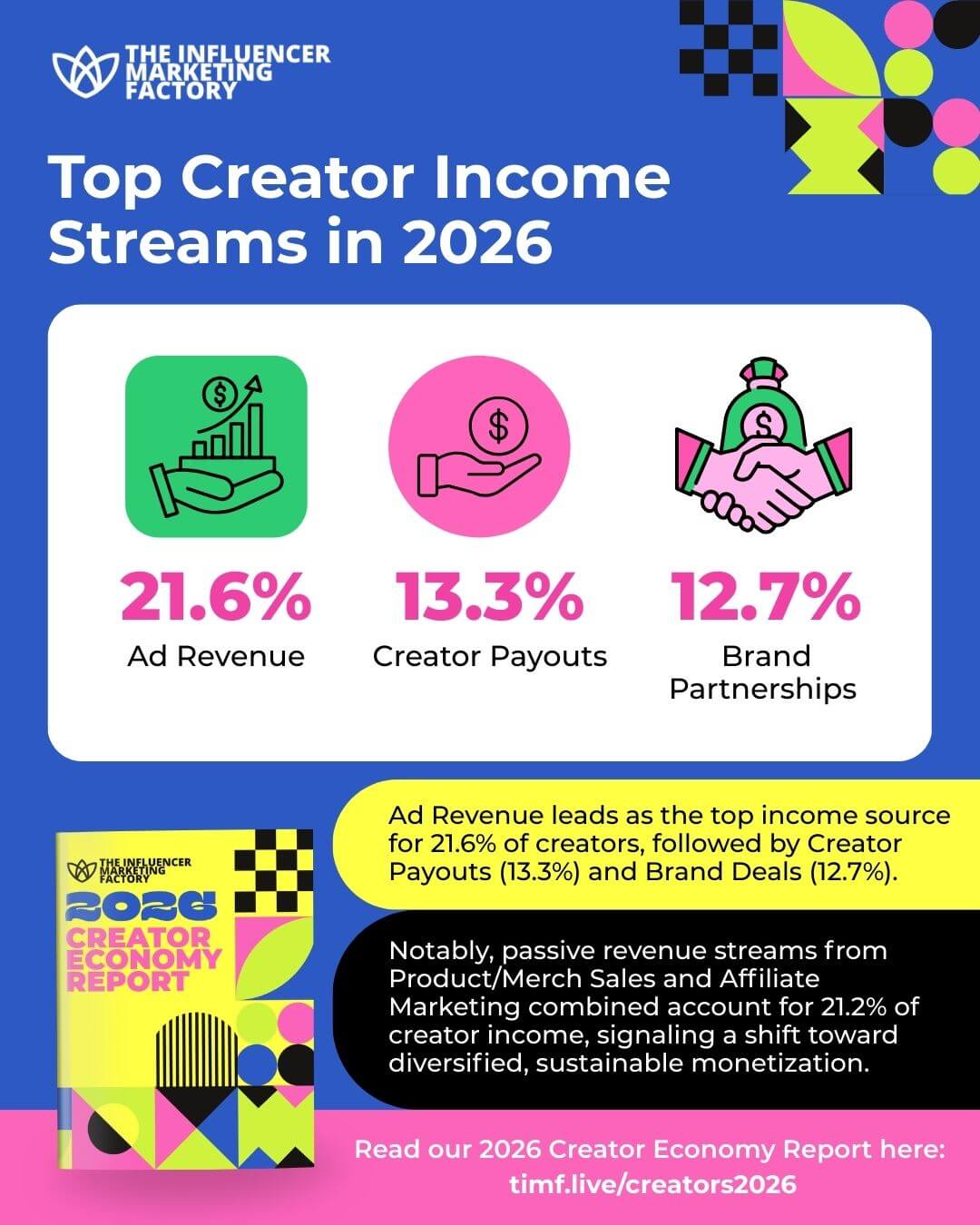
Top Creator Income Streams in 2026
Survey Finding #2: The Creator “Middle Class” Has Emerged
48.7% of creators earn under $10K annually, while 45.6% earn between $10K-$100K and 5.7% earn 100K+, signaling the emergence of a viable “middle class” in the creator economy who are successfully monetizing their content.
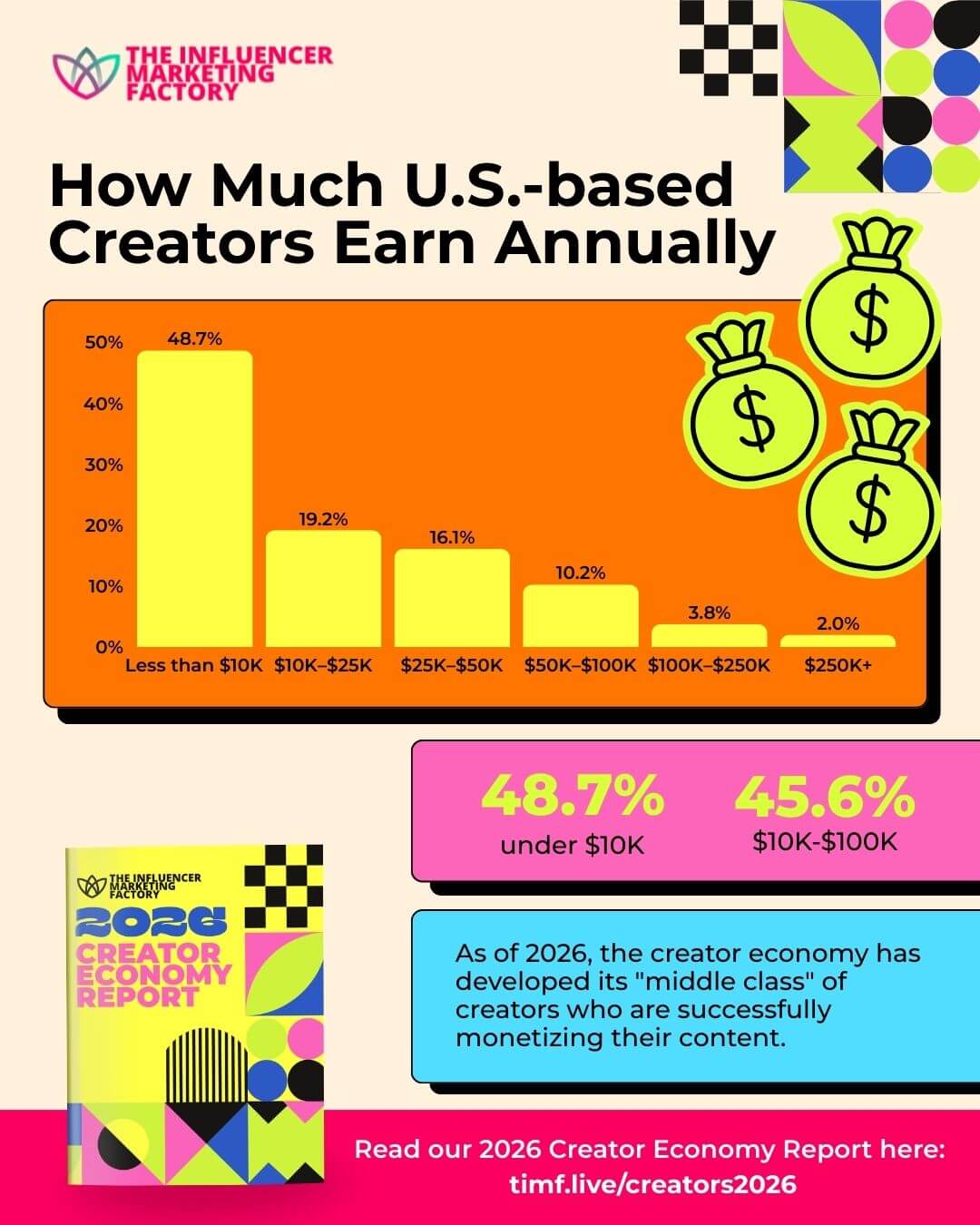
How Much US-based Creators Earn Annually
Survey Finding #3: The One-Off Campaign Era Is Over, Creators Prefer Partnership Stability
44.9% of creators value stability, consistency, and deeper brand alignment over one-off campaigns. This preference reflects creators’ growing business sophistication, as they recognize that long-term partnerships deliver more predictable income, reduce time spent on constant pitching, and result in more authentic content that resonates with audiences.
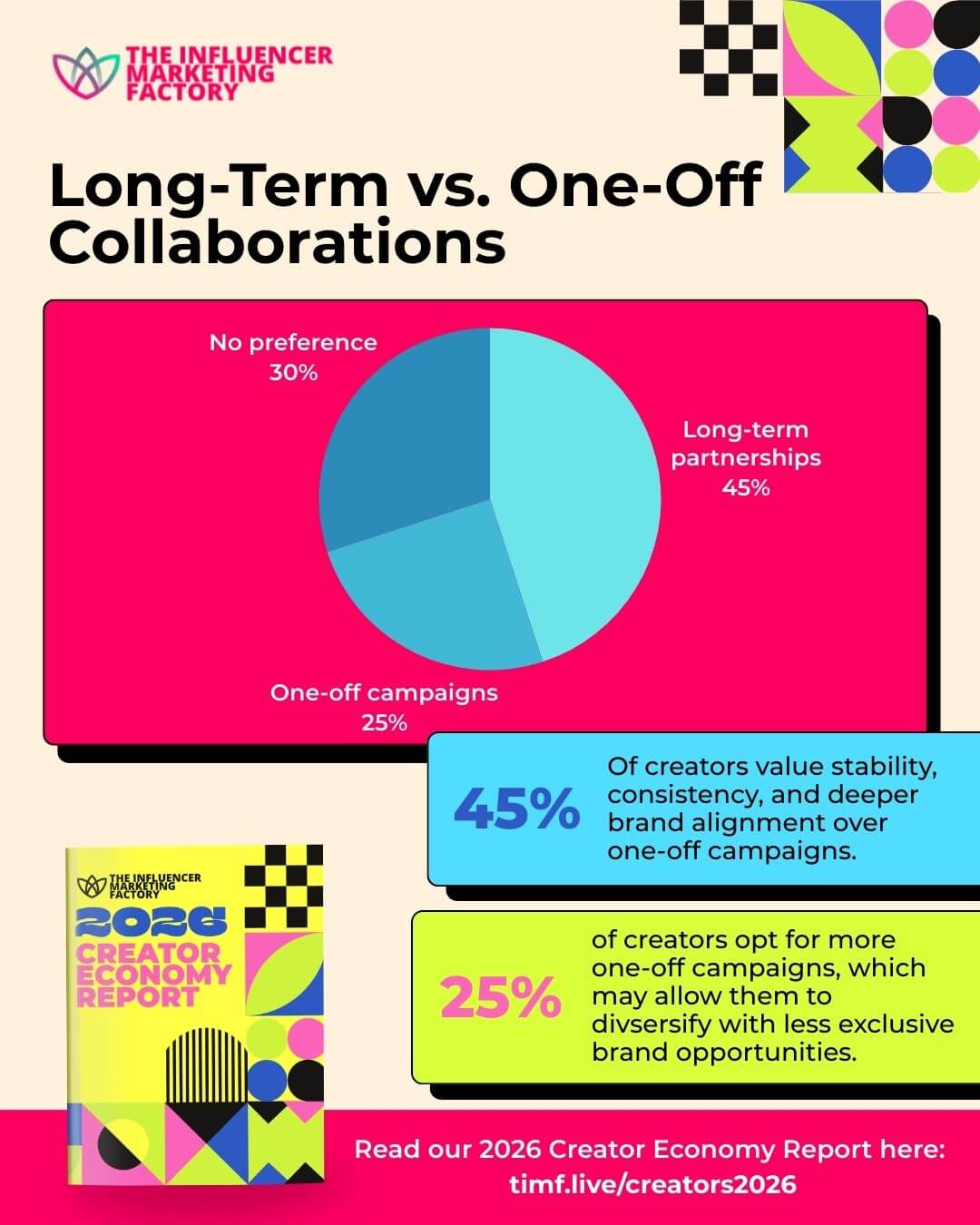
Long-Term vs One-Off Collaborations for Influencers and Creators
Survey Finding #4: Half of All U.S. Creators Grew Their Earnings in 2025
51.5% of creators achieved earnings growth year-over-year in 2025, a remarkable statistic given the algorithm volatility and increased competition that defined the year.
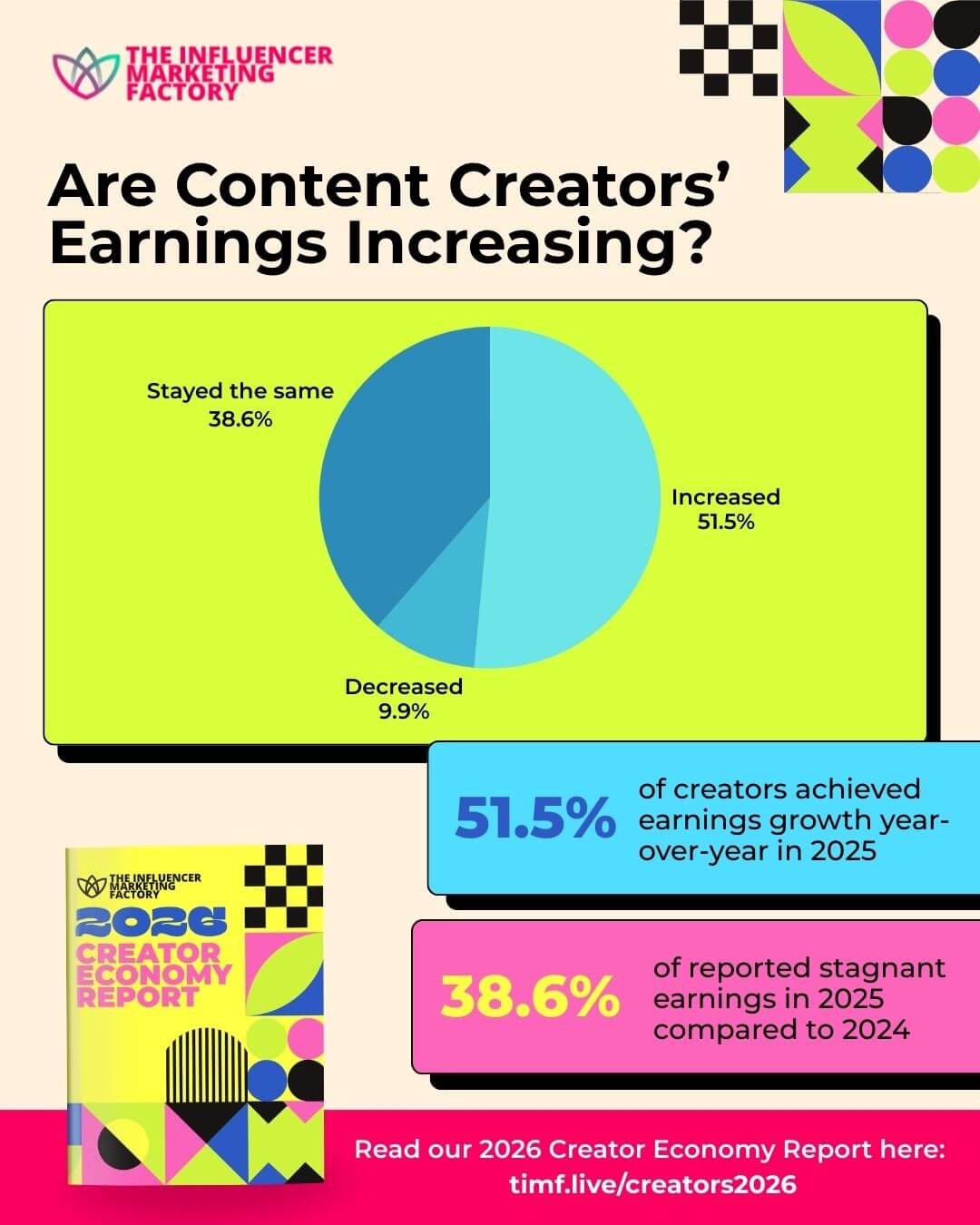
Content creators’ earnings are increasing
Survey Finding #5: Creators Shift to Strategic Brand Building in 2026
Creators’ focus on video production (22.4%) and branding (20%) reveals a strategic pivot toward professionalization, with nearly half of all professional development efforts concentrated in these areas. This professionalization trend signals that 2026 rewards the strategic creator-entrepreneur, not just the prolific content maker.
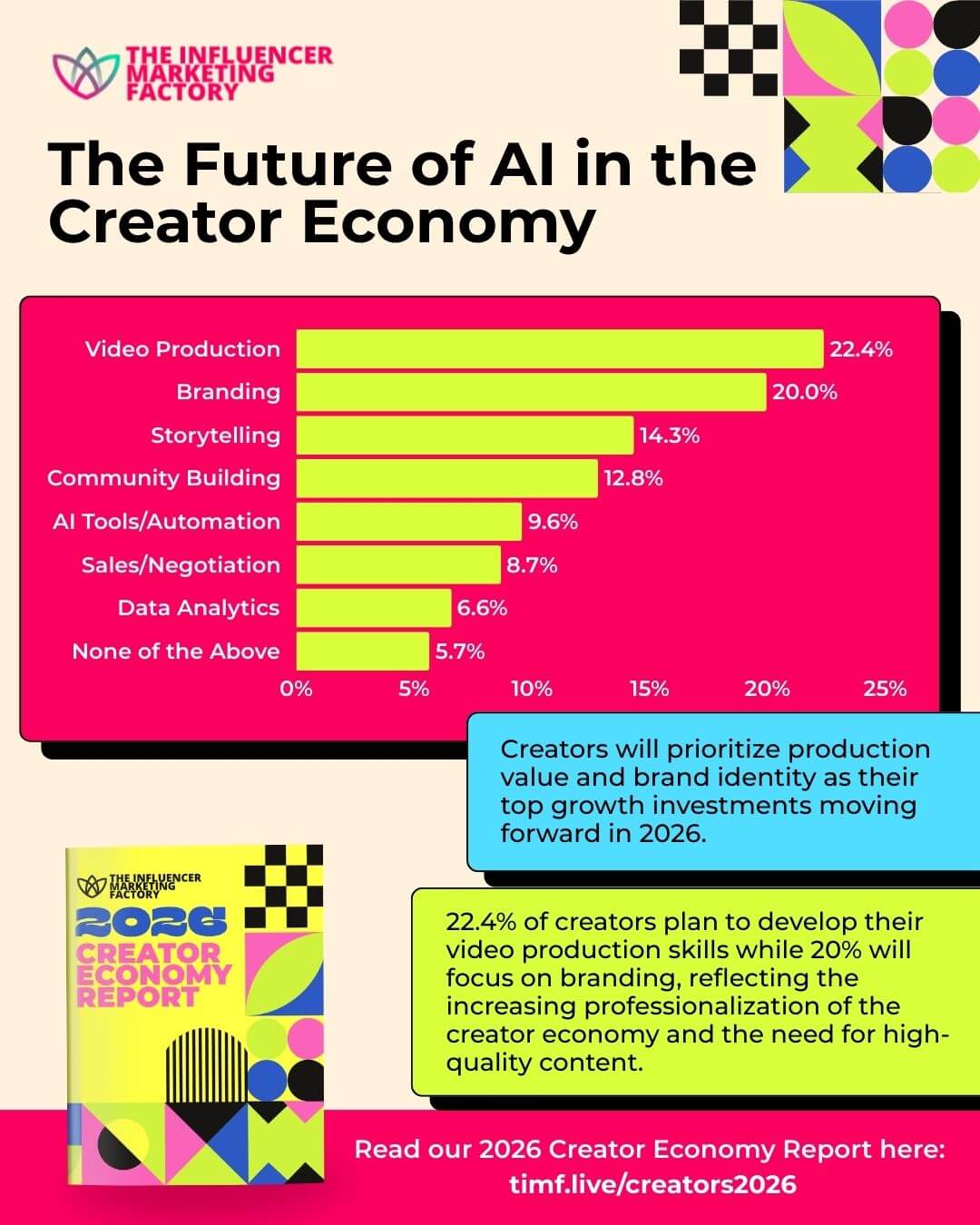
The Future of AI in the Creator Economy
2026 Top Creator Platforms & Tools Comparison
Essential Creator Tools for 2026
As creators shift toward professionalization and strategic brand building, the right operational tools have become essential differentiators in 2026. Our team at The Influencer Marketing Factory evaluated and compared the leading platforms across key creator use cases, from managing multiple revenue streams to optimizing content workflows, to identify which tools deliver measurable value for professional creators.
| Platform Category | Top Creator Apps & Platforms |
| AI Platforms 🤖 |
|
| Monetization Tools & Platforms 💰 |
|
| Newsletter Platforms 📰 |
|
| Podcasting Platforms 🎙️ |
|
| Digital Product Platforms 💻 |
|
| Content Creation Tools 🎨 |
|
| Social Commerce Platforms 🛒 |
|
| Link In Bio Tools 🔗 |
|
Download The Creator Economy 2026 Report for FREE
Expert Predictions: What Industry Leaders Say About What’s Next in the Creator Economy
We interviewed top creator economy experts, platform executives, and marketing leaders to understand where the industry is heading in 2026.
Alexander Frolov – CEO & Co-Founder, HypeAuditor
Alexander Frolov – CEO & Co-Founder, HypeAuditor
AI will be built into most workflows, helping marketers with tasks like finding and analyzing creators, forecasting performance, and testing messages. Since AI will be everywhere, the ones who succeed will be those who use it to speed up the work but still trust their own judgment, staying in the driver’s seat and leaving AI as a co-pilot.
As AI spreads and many touchpoints start to feel generic, this mix of measurable impact and human, community-led content will be a key reason to invest more in influencers.
Alex Zaccaria – Co-Founder & CEO, Linktree

Alex Zaccaria – Co-Founder & CEO, Linktree
Today, creators are spending less time trying to win on individual platforms and considerably more time building sustainable businesses.
2026 is cementing a shift toward ownership, diversification, and direct, authentic relationships with audiences. That means that tools that can help creators manage that complexity matter more than any single algorithm or platform decision.
Jared Carneson – Head of Global Social Media, Adobe

The clearest patterns across the strongest social work this year, from brands and creators alike, revealed a shift away from ‘campaign thinking’ and toward programming thinking.
The best brands no longer aim to win a single moment; they architect content systems that are serialized, character-driven, community-activated, globally scalable, and increasingly AI-powered. They are behaving less like advertisers and more like IP houses.
Gigi Robinson – Founder, Creator, & Author, Hosts of Influence

Gigi Robinson – Founder, Creator, & Author, Hosts of Influence
In 2026, the creator economy will move from being attention-driven to ownership-driven. We’ll see fewer creators chasing one-off brand deals and more building real businesses with diversified revenue streams, long-term partnerships, and IP they actually own.
Influencer marketing will shift toward creators who can demonstrate business impact, not just reach, meaning creators who understand audience trust, community, and conversion will outperform those relying on vanity metrics. Platforms will still matter, but creators who think cross-platform and off-platform will be the most resilient. The gap between “content creators” and “creator-entrepreneurs” will widen and the latter will define the next era.
Frequently Asked Questions About the Creator Economy
How Much Do Influencers Make? (2026 Creator Earnings & Revenue Trends)
Influencer earnings can vary dramatically based on follower count, niche, engagement rates, and monetization strategies. Our 2026 Creator Economy Survey reveals the following breakdown of annual creator income in the United States:
- Micro-Earnings (Under $10K): 48.7% of creators
- Emerging Professional ($10K-$25K): 19.2% of creators
- Mid-Tier Income ($25K-$50K): 16.1% of creators
- Full-Time-Earning Content Creators ($50K-$100K): 10.2% of creators
- High-Earner Tier ($100K–$250K): 3.8% of creators
- Top-Earning Creators ($250K+): 2% of creators
What platforms generate the majority of creators’ income?
Our team at The Influencer Marketing Factory surveyed 1,000 U.S. creators to identify current monetization trends and platform preferences. The following breakdown highlights the three highest-earning social platforms for creators in 2026.
| Ranking | Top Social Media Platforms | Percentage of U.S. Creators |
| #1 | TikTok | 37.8% |
| #2 | YouTube | 34.1% |
| #3 | 16% |
How do I start influencer marketing for my brand in 2026?
To launch a successful influencer marketing program in today’s landscape, brands must move from transactional posts to strategic partnerships. Follow these steps to maximize your influencer marketing ROI in 2026:
- Define Clear Performance Objectives: Whether your goal is brand awareness, social commerce sales, or community building, your specific KPIs will help determine your creator selection and platform strategy.
- Target Micro-Influencers for Higher Engagement: Partner with micro-creators (typically 10K-100K followers) within your specific niche. These creators often provide the most cost-effective path to reaching a highly attentive, loyal audience.
- Prioritize Brand Alignment Over Follower Reach: Authenticity is the primary driver of conversion. Choose content creators who genuinely share your brand values and naturally integrate your products into their existing lifestyle.
- Invest in Long-Term Brand Ambassadors: Shift away from one-off campaigns and toward multi-month partnerships. Consistent brand visibility through the same creator builds deeper trust and significantly improves long-term conversion rates.
- Empower Creators with Creative Freedom: While brand guardrails are necessary, successful campaigns allow creators to maintain their unique voice. They understand their community’s preferences better than any external brand team.
- Track Full-Funnel Marketing Metrics: Move beyond vanity metrics like impressions. Focus on engagement rates, click-through rates (CTR), and direct conversions to accurately measure the success of your influencer spend.
To learn more about kickstarting your next influencer marketing campaign, get in touch with our team at The Influencer Marketing Factory here!
What’s the difference between micro and macro influencers? Which should I choose for my influencer marketing campaign?
When it comes to influencer marketing, brands rely on key metrics such as ROI, engagement, and conversions to make informed decisions. Here’s a breakdown of these metrics for micro and macro influencers to help support your 2026 creator marketing strategy:
| Metric | Micro Influencers | Macro Influencers |
| Influencer Marketing ROI | Often higher due to targeted engagement and lower costs. Effective for niche campaigns with specific audience targets. | Potentially lower due to higher costs, but can achieve significant brand visibility/awareness across broader digital audiences. |
| Engagement Rates | Higher engagement rates due to personal connections with the audience. Their content often fosters meaningful onlineinteractions. | Lower engagement rates, on average, are observed due to larger follower bases, but the sheer volume of followers can result in substantial interactions. |
| Conversions | Higher conversion rates as followers trust their recommendations, making them ideal creators for driving sales across niche markets. | Conversions may vary; while individual rates might be lower, the extensive reach can lead to a significant number of overall conversions. |
To learn more about micro and macro influencers, check out our full blog here.
Should creators focus on TikTok or Instagram Reels in 2026?
TikTok maintains the most creator-friendly algorithm with consistent engagement rates across all audience sizes, while Instagram Reels shows declining engagement as follower counts increase. TikTok’s democratized reach means 76% of creators get under 1K views per post, but those who break through maintain steady performance. For maximum reach and fairness, TikTok offers better odds for small creators, though a multi-platform presence is ideal to counter platform volatility.
Who are the key creator audiences in 2026?
As outlined in our 2026 Creator Economy Survey, the 25-34 demographic remains the cornerstone of the creator economy in 2026, representing the largest audience segment and the highest concentration of “professionalized” creators. This cohort serves as a critical bridge for brands, offering high purchasing power and established brand loyalty.
While older Millennials provide stability and high-intent conversions, Gen Alpha has emerged as the next essential target. As the most influential household decision-makers, Gen Alpha’s preferences now drive over $28B in direct spending, pushing brands like Sincerely Yours and Yes Day to launch with “Alpha-first” strategies. By capturing both the disposable income of the 25-34 group and the rising cultural influence of Gen Alpha on platforms like TikTok and Snapchat, brands can execute more effective, multi-generational influencer marketing campaigns.
How will AI impact the creator economy?
Artificial Intelligence has become a foundational tool in the modern creator economy, with 91.9% of creators now utilizing at least one AI tool in their creative workflow, according to our 2026 Creator Economy Survey. Far from replacing the creator, AI acts as a “productivity multiplier,” allowing influencers to automate repetitive tasks and focus on their popularized, authentic storytelling.
Here is how professional creators are currently deploying AI, as outlined in our survey:
- Multimedia Editing (24.7%): Using AI for automated video clipping, audio cleaning, and photo enhancement.
- Idea Generation (21%): Leveraging large language models (LLMs) to brainstorm trending topics and content themes.
- Script & Caption Writing (17.2%): Drafting social copy, video scripts, and captions.
- Analytics & Insights (16.7%): Analyzing audience data and sentiment to optimize posting schedules and content performance.
- Automation & Scheduling (12.3%): Streamlining back-office workflows, from auto-posting to managing brand deal inquiries.
As AI makes content production faster and more accessible, human authenticity has become the primary differentiator for brands and audiences alike. Successful creators in 2026 are doubling down on what AI cannot replicate: personal lived experiences, unique perspectives, and genuine community engagement.
Download the Full 2026 Creator Economy Report
Get the complete 62-page report with:
✓ 30+ data-driven charts and visualizations
✓ Platform-specific strategy recommendations
✓ Exclusive insights from creator economy experts
✓ 2026-2027 trend predictions and forecasts